Mr. Gates, Rotarians, and polio

The Gates Foundation (do we still have to refer to it by its full, formal name?) is giving a whopping $255 million to help eradicate polio from Earth.  Bill made the announcement to a Rotary International conference today (1/21/09), because the Rotarians have been leading the push for polio eradication (raising money, volunteering, and using their local branches in places like India and Nigeria to push for political support).

Polio remains present in just four countries — India, Nigeria, Afghanistan, and Pakistan.   You can imagine the political/warfare challenges to delivering vaccine to remote villages in the “-stans.”  In India, the pockets of disease are also in remote areas (mostly in Uttar Pradesh).  And Nigeria has had a host of troubles, including a rumor five years ago that the vaccines were a plot against Muslim girls.  That caused a huge setback and a resurgence of the disease.

Some additional challenges today have to do with how polio behaves in the presence of other endemic diseases.  In those cases, it’s harder for the vaccine to provoke immunity, and more doses are required (sometimes 10 doses!).

There’s been a lot of debate over whether it’s worth the huge cost (billions of dollars) to wipe out the last few cases of one disease, when so many other diseases are causing more harm.  There are now fewer than 2,000 cases of polio a year.  But global health leaders say the resurgence we saw in Africa after the Nigerian troubles shows that you can’t permanently contain this highly contagious disease.  (It’s spread by a virus, either in contaminated water or by people who are carriers.)

Gates gave quite an inspirational speech to the Rotarians in San Diego.  I didn’t get a chance to hear it, but I was sent a transcript.  It turns out his wife Melinda has an aunt who was afflicted with polio, and has been in braces most of her life.

If the campaign succeeds, polio would be the second disease eradicated, after smallpox (officially gone as of 1980, according to the World Health Organization).

Movie theaters find second life, as third place

Digital technology (the savior or nemesis off all types of media) has a new role in movie theaters.  At least that’s the spin I got from the CEO of a small chain, called Galaxy Theatres, based in Sherman Oaks, CA.

Cinemas used to be limited to whatever films they had on-hand during any given week.  By going “digital,” they can play video from many potential sources — anything you can send via the internet or a satellite.  In addition to playing movies, they could show big-screen Monday Night Football in 3-D.  Or, host a giant viewing party for the Presidential Inauguration.  Or, rent the theater out for a myriad of possible personalized showings.

“Take the words ‘Movie Theater’ off the building.  What do you have?” asks Frank Rimkus, CEO of Galaxy.  I didn’t have much of an answer, so (surprise!) he had his own ready.  He calls it a state-of-the-art presentation facility, with a screen that’s two stories tall.  “If you’ve got that kind of building, what else can you do with it? That’s the question.”

In other words, maybe you’re proud of your 48-inch screen and surround sound at home.  But Galaxy boasts a 900-inch screen.  For extroverts: You could watch with 200 of your closest friends. And, as movie theaters experiment with restaurant-style food, you can imagine a near future where “going to the theater” is a little bit like going to a sports pub.  Voila – a new type of “third place” (a term coined by Ray Oldenburg to refer to social gathering spots).

Galaxy is trying to establish itself as a community gathering spot.  Tomorrow (Wednesday, 1/21/09), in Gig Harbor, WA, it’s playing middleman between the public schools and NASA.  A thousand public school students from the Peninsula School District will have a live satellite connection from the theater to the International Space Station.

The live 20-minute Q-and-A with two astronauts couldn’t happen at one of those old movie theaters using film.   (It’s free and open to the public, by the way, with doors opening at 9:30 am.)

So far, Rimkus says only about 10% of America’s cinemas have upgraded to digital projection.  The Cinerama in Seattle was one of the first.   But he predicts a massive changeover in the next five years.  “The industry is basically taking old propeller airplanes and replacing them with jets,” he says.

Hey, maybe Starbucks, promoter of the Third Place concept, could get into this … bring your laptop, have a latte, and watch a giant screen.

Smart dummies, spreading

Simulation is becoming a trendy buzzword in medicine.  Technology has advanced to the point where a lot of medical procedures can be practiced on high-tech mannequins, or via computer simulations.  A few studies have shown better outcomes for doctors who trained first on simulators, although the evidence is still somewhat preliminary. I have a story airing tomorrow (Thursday) on KPLU about the mannequins.  (Update 1/15 – story now posted here.)

I didn’t have room to mention in the story some of the expansion that’s in the works locally.  The University of Washington’s main simulation center, called ISIS, is not only in new digs at the surgery pavilion.  They’re getting ready to add a much bigger simulation center at Harborview hospital, possibly by the end of 2009, and another one after that at Seattle Children’s Hospital.  Then, there are plans to offer continuing medical education courses using the U.W. simulators.

That should keep the U.W. as one of the national leaders in medical simulation (the top spot is generally considered to be Stanford’s sim center).

The U.W. will be competing locally with Swedish Medical Center, which just opened its own simulation center, and expects to rent it out to train teams from other local hospitals.

The mannequins have come a long way from the old Resusci-Annie, used for CPR training.  They are still clearly dolls, so, as hospitals around the country start buying into simulation, expect to see a lot more innovations.  (Good news for the Norwegian company Laerdal, which invented the Resusci-Annie, and still makes the most popular mannequins.)

Laerdal's SimNewB

Laerdal's SimNewB

Also, for a nice overview of the use of simulation to make better medical teams, see Tom Paulson’s recent story in the P-I.

Understanding an avalanche

Our newsroom has been consumed just keeping up with fresh information about the flooding and storm impacts.  No time this week for a deeper look at anything.  But, this would have been a good topic:  Mark Moore of the Northwest Avalanche Center grabbed my attention during a news conference about the weather on New Year’s Eve.

He declared that the avalanche danger had become  “extreme.”  He explained, with a series of slides, how it’s not just having a large snowfall that makes for an avalanche.  It’s the type of snow and the temperatures during each successive snow-storm that make for a big hazard.  We saw this come true on the mountain passes last week, and especially this week.

This landslide/avalanche near Snoqualmie Pass took out not only all the layers of snow, but several  inches deep of soil as well — and a ski lift.  (I haven’t done any deeper research on this, but I’m pretty sure it has the same fundamental cause as the all-snow avalanches.)

Avalanche and landslide at Hyak (Snoqualmie Summit East)

Avalanche and landslide at Hyak (Snoqualmie Summit East) (WSDOT)

Check out the full gallery of photos posted by WSDOT.

And for a nice info-graphic explaining the underlying science, plus a profile of the scientists, see Tom Paulson’s story in the P-I (published just before the Hyak slide came rumbling down).

A manly march out of Africa

I like to imagine what life might have been like for our ancestors.  You can do this with any time period — going back to your great-grandparents, or a few centuries before that, or way back in evolutionary time.  In today’s case, how about 60,000 years ago?

That’s the era when Homo Sapiens were migrating from the Africa to the Middle East, and spreading from there to populate Asia, Europe, Australia and the Americas.  These people were anatomically the same as us.  And it’s surprising how much anthropologists have been able to deduce about them:  They were hunter-gatherers, and probably their lives were similar to hunter-gatherer communities that persisted into the 20th century.

And now there’s evidence that the bands of migrating humans, who probably worked their away across what we now call Egypt and the Sinai, included more men than women.  Alon Keinan of Harvard Medical School, and colleagues, used genetic markers to detect a surprising anomaly in human DNA that must have been triggered about 60,000 years ago.

They compared the genomes of modern people of West African descent with people of European and Asian descent.  The non-Africans show a series of random changes in their X chromosomes, known as “genetic drift,” which only seems to make sense if non-Africans all descended from a group where men outnumbered women.

(I’m skipping over the scientific methods for making these calculations, but it’s worth noting that this type of analysis is possible only using the tools developed for the Human Genome Project.)

We may never be able to say with confidence why those bands of people left.  A writer at New Scientist speculates that warfare might have played a role — that the migrants might have been similar to marauding Vikings.  Or, at the least, they may have been like more recent examples where male explorers and settlers went first (and women were in short supply).

This doesn’t imply that gender relationships back then were structured in any specific way.  But, it’s fair to imagine a charismatic leader, a visionary, whose name we’ll never know, who led early exploring parties up the Nile River, and out of Africa — 60,000 or more years ago.  The first “age of exploration”?

The study was published this month in Nature Genetics.

Malaria and the Holy Grail

Ah, the dilemma of Hope vs. Hype. I reported earlier this week that medical researchers and global health activists (including many at PATH in Seattle) are feeling a bit of success in the latest test of a malaria vaccine. It appears, so far, to be the best hope for protecting people living in malaria-infested areas. Malaria kills about a million people every year, mostly children in sub-Saharan Africa.

What I only mentioned, but didn’t have time in my radio report to explore, was the fact that the vaccine is still barely more than 50% effective. There’s no telling whether it will be better or worse than 50% once it gets into a less controlled context, in a final field trial that starts next year.  It likely will leave roughly half the population unprotected.

There are other potential malaria vaccines in the pipeline.  If any of them proves practical and at least partially effective, then you might combine two vaccines, and maybe make a big difference.  This would be like creating the “cocktail” of drugs that are helping AIDS patients survive.

Other researchers say we need a vaccine that’s at least 90% effective, ore else we’re going to allow malaria to remain the scourge of Africa.  But, there are vast challenges (scientific, technical) in creating a vaccine that good.  One candidate comes from Stefan Kappe’s lab at Seattle Biomedical Research Institute.  You can listen to my profile of him from last year, or read a recent profile by Luke Timmerman at Xconomy.com.

And, there are entire websites devoted to debunking all this as hype.

I think it’s great for science and possibly for human welfare that the Gates Foundation and others are funding this research into malaria.  But, for the next decade at least, it looks like old-fashioned remedies will have to do.

Flunk that report card

Do Washington state residents have some of the worst access to emergency medical care in all of America? That’s what a reputable organization would have you believe. The American College of Emergency Physicians issued what they call a “report card” on the 50 states. They rank Washington at the very bottom when it comes to availability of hospital beds and psychiatric beds, and near the bottom in the availability of registered nurses.

But, the state Department of Health has no evidence of such a severe shortage. Spokesman Donn Moyer asked the various data-crunchers within the agency, and they concluded, “This isn’t how we would quantify access to care.” He says they can’t understand why the Emergency Physicians would measure hospital beds “per capita,” because that’s not a method that’s typically used in the world of public health.

What does this mean?

(a) there’s a hidden crisis brewing in Washington, unseen by our officials, with people getting turned away in growing numbers as they seek hospital care

(b) having fewer hospital beds in your state does not automatically translate into lack of access to care by people who live in that state

(c) an interest group has created a report that – surprise – serves the interest of its members (by advocating for more spending on hospitals and medical staff)

I would go with both (b) and (c). To believe (a), you’d have to think everyone at hospitals and in the emergency medical system is keeping quiet about a major problem, which is worse here than the rest of the country. And, they only decide to speak up when ACEP releases its bi-annual report.

Do “diversions” happen, when an Emergency Room is full, and a patient is sent to an E.R. that’s not necessarily the closest? Yes, but that also might be a sign that we’re using the medical system efficiently. What do you think?

“Assisted lethal medication”

We’re having a lively discussion in the KPLU newsroom about the language surrounding the recently passed Initiative-1000. It’s called the “death with dignity” law by supporters, and “physician-assisted suicide” by opponents.   A judge ruled last spring that the ballot title would not include a reference to assisted suicide, preferring instead more neutral language. Last summer, the Associated Press decided to call it “assisted suicide” – and that is the source of copy for many stories we read over the air on KPLU.

Here’s the challenge for radio and TV broadcasters: It doesn’t always work to say aloud a phrase like, “the measure that allows terminally ill competent adults to obtain lethal prescriptions.” We need a shorthand phrase. That’s one reason why the AP went with assisted suicide.

The other reason is, we prefer to be clear and descriptive, and to avoid speaking euphemistically. The phrase “assisted suicide” seems to summarize what the law allows. In the past, it was illegal for a doctor to prescribe medication that would enable someone to end their life. Now, the initiative makes it legal to provide such assistance. Taking your life is called suicide. What could be more clear?

In the medical community, it looks like “physician-assisted suicide” has been used for some time to describe Oregon’s law. And the Washington State Medical Association on its homepage says, “Washington has become the second state to legalize physician-assisted suicide.”  (But, the WSMA also opposed the initiative.)

I asked Colin Fogarty how he handles this issue. He covered Oregon’s lethal prescription initiative for many years for Oregon Public Broadcasting and National Public Radio. (He now edits stories heard on several public radio stations, via the Northwest News Network.) He says they had frequent newsroom debates, but came down on the side of “assisted suicide,” because it seemed the most clear and accurate.

Those who campaigned for the initiative say the word “suicide” has negative connotations. And they say the people authorized to take the lethal prescriptions are already diagnosed as being in the process of dying. So, the medication is hastening their death, not exactly causing it.

I’m sympathetic to this argument. If I’m dying of cancer, and I speed up the process by a month or two, you still might say I died of cancer. Under the law, my death certificate must list the underlying terminal disease. But, you’re also leaving out part of the story, so it doesn’t feel completely transparent.

The news business is a little different from the legal business.  Our credibility depends on being transparent and straightforward. So, for now, we’re sticking with “physician-assisted suicide,” but we’ll do our best to also include phrases such as, “the Death with Dignity Act,” or “aid in dying.”


Envisioning Tsunamis

While I was learning about massive tsunamis this past week, for stories on KPLU and a show called The World, there were some memorable tidbits:

– Waves 90-feet high on the Cascadia Subduction Zone!  Not sure where that is?  It’s basically the Pacific coast from Humboldt, California through Oregon and Washington, to southern British Columbia.  If you’ve been paying attention, you already know it’s not only an earthquake zone, but a major tsunami zone.  The fault is very similar to the one that ruptured near Sumatra on December 26, 2004.  And since then, geologists in the Pacific Northwest are adjusting their hazard maps to allow for the possibility of 60-90 foot waves in some coastal towns.

When will the next catastrophic wave come?  Ahh, that’s what everyone wants to know.  This week’s news is that it’s been about 600 years between big tsunamis in Sumatra and Thailand.  As Sandy Doughton put it in The Seattle Times, that dates it back to the era of Joan of Arc.  It’s long enough for the rise and fall of a civilization.  You can see the evidence, as it’s beautifully preserved north of Phuket, Thailand.  This photo shows the layers of light colored sand from tsunamis, and dark colored soil that builds up in the centuries in between.  The woman is a Thai scientist, Kruawun Jankaew,  who worked with Brian Atwater of the USGS and University of Washington.

phohto by Brian Atwater, USGS/UW

photo by Brian Atwater, USGS/UW

Along the Pacific coast, we also measure in centuries.  The last one hit in January of 1700 (the subject of fantastic sleuthing and science by Atwater and recounted in his book, The Orphan Tsunami of 1700).  Going further back is less precise, and it may be anywhere in the range of 300-1,000 years between big tsunamis.  We could be due now — or it could be beyond our great-great-grandchildren.  The fault-lines don’t follow much of a schedule.

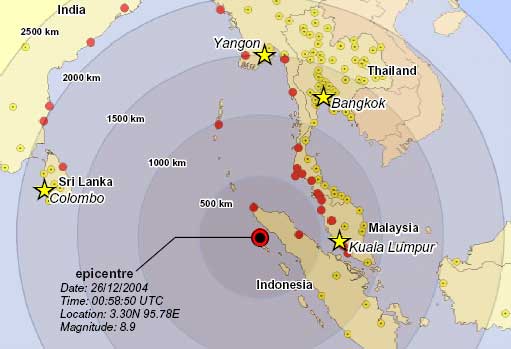
– There was no epicenter in 2004.  The 2004 Sumatran disaster was huge in many ways.  At magnitude 9.2, it’s one of the biggest earthquakes ever recorded.  And the fault rupture was nearly 1,000 miles long (as if a single earthquake stretched from Seattle to San Francisco).  As Atwater put it, we normally use an image of the quake and tsunami that’s like a pebble dropped into a pond, rippling out in circles.  Here’s an example used by the United Nations and the US Agency for International Development

from USAID website "Tsunami Reconstruction"

from USAID website, Tsunami Reconstruction

But this is wrong.  It’s more like someone threw a long log into the pond — and the tsunami waves rippled out primarily in two directions.  Instead of a red dot and circles, imagine a long red line, with waves emanating to the left (Sri Lanka) and right (Thailand).   And, if you’re still following this, along Washington and Oregon, we should expect something similar, with a long section of the fault rupturing.

Will health solutions equal healthy profits?

If you happen to live in a Presidential battleground state, such as Ohio, Pennsylvania or Florida, you might have heard Sen. McCain talking effusively on the stump about how to revolutionize health-care — using information technology. Sen. Obama has sounded pretty similar.

It’s not an obvious campaign pitch, at least at first. Those of us here in the Pacific Northwest have missed most of this discussion. I got interested when I saw how lucrative it might be.

Electronic health records have been a priority within the health care industry for a while. Getting rid of all those paper files is supposed to lead to fewer medical mistakes and a more efficient system. If you walk into an emergency room (or a clinic you’ve never visited), the doctor or nurse could call-up your medical history, including medications and allergies, and not rely on anyone’s memory.

Reformers who love electronic records envision a day when patients are “empowered” by having access to all their records. Personally, I like the idea of having access to and control of my records. And it definitely sounds more efficient. But once you’ve got a long medical rap sheet, couldn’t it still be too much information for the doctor to scroll through? Especially for your 10-minute appointment?

You can run a full-day seminar on all the lingering privacy issues.

It’s also a big expense on the horizon. I stopped by a conference in Seattle, of health information specialists (a group called AHIMA), and I learned that only about 15-17% of hospitals and medical practices have invested in the computer technology upgrades. Wow – more than 80% still have to buy new computers and servers and a bunch of software, to make the conversion. No wonder software and computer companies are excited. Even Microsoft is getting into the act, with a new division called the Health Services Group.