
Vaccine subsidies may end

My story on KPLU about a proposal to end state subsidies of childhood vaccines only brushed over the impact on pediatricians and family doctors.  It was a short story, written for a newscast.  This is not the most important budget cut pending in Olympia, or the one that will impact the most people.  But, it’s an example of a good program that probably is in trouble in this economy.

I traded messages with the president of the Washington chapter of the American Academy of Pediatricians.  Dr. Neil Kaneshiro wrote an eloquent explanation of what it might mean:

The burden on the pediatrician depends on how they respond to the change. As you have found out, it is a dramatic shift in policy. In the “old days” before Universal Purchase, pediatricians used to see kids for their checkups and then send them to the health dept for their vaccines. Not a very good system as some of those parents didn’t bother or weren’t able to take the kids in to a separate facility on a different day possibly missing work again just to get their vaccines. Now the vast majority of immunizations for kids are delivered in the pediatrician/family practitioner office because the immunization program makes it a seamless process. The benefits for kids were easy to see. No hassles and no barriers to immunizations. Immunization rates improved. (Many will say that Universal Purchase does not correlate with high immunization rates. That is true, but it definitely helps the rate by removing all financial barriers to immunizations so that any parent who wants one for their child can get it. The problem with immunization rates in Washington State is primarily with the strong anti-immunization sentiment fueled by celebrities like Jenny McCarthy. We have the highest proportion of families who opt out of school mandated vaccines in the nation.)

There are significant costs associated with provision of immunization services. Ordering, inventory, refrigeration/freezer capacity, needles, syringes, nurse/medical assistant time, physician counseling of patients.
Those are the costs with the current Universal Purchase program. When that is taken away, several other things come into play.
1. Acquisition cost. I estimate we have $150,000-200,000 worth of vaccine in our refrigerator and go through that monthly.
2. We would need vigilant monitoring of insurance reimbursement because doctors in other parts of the country have lost significant amounts of money because insurers were not reimbursing less than the actual cost of vaccine.
3. We would need to set up an entirely separate ordering and inventory system and institute failsafe measures to prevent vaccine from moving from VFC stock to Commercial stock and vice versa. Lots of potential fraud issues arise if VFC vaccine is used for someone with Blue Cross insurance. And potential bankruptcy issues arise if purchased vaccine is given to Medicaid kids.

Medicaid reimburses essentially nothing for the above services. Commercial insurance reimburses for the administration, but sometimes not the ordering, inventory refrigeration, insurance/overhead costs. The unspoken deal with the state was that physicians would move immunization services for Medicaid into the medical home since they were providing vaccines for everyone. In turn the state would be able to reduce the immunization infrastructure in the public health system as the primary care providers were taking care of it.

Depending on individual pediatricians vaccine purchasing power and negotiating position with insurers, buying and selling vaccine could be either profitable or not. Pediatricians are unfortunately not known for their business savvy and this will cause some practices to go under or stop doing immunizations.

I think that since pediatricians lose money every time they give a vaccine to a Medicaid child, it is possible that the financial strain will force some to revert back to the old system of referring kids to the health department for immunization services. Unfortunately much of that public health infrastructure has been dismantled and is unlikely to be rebuilt under the current budget situation.

The bottom line is that this will introduce barriers to immunization for kids that are not there now and our immunization rates will fall.
Smart dummies, spreading

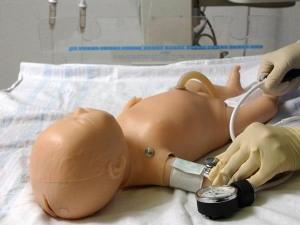
Simulation is becoming a trendy buzzword in medicine.  Technology has advanced to the point where a lot of medical procedures can be practiced on high-tech mannequins, or via computer simulations.  A few studies have shown better outcomes for doctors who trained first on simulators, although the evidence is still somewhat preliminary. I have a story airing tomorrow (Thursday) on KPLU about the mannequins.  (Update 1/15 – story now posted here.)

I didn’t have room to mention in the story some of the expansion that’s in the works locally.  The University of Washington’s main simulation center, called ISIS, is not only in new digs at the surgery pavilion.  They’re getting ready to add a much bigger simulation center at Harborview hospital, possibly by the end of 2009, and another one after that at Seattle Children’s Hospital.  Then, there are plans to offer continuing medical education courses using the U.W. simulators.

That should keep the U.W. as one of the national leaders in medical simulation (the top spot is generally considered to be Stanford’s sim center).

The U.W. will be competing locally with Swedish Medical Center, which just opened its own simulation center, and expects to rent it out to train teams from other local hospitals.

The mannequins have come a long way from the old Resusci-Annie, used for CPR training.  They are still clearly dolls, so, as hospitals around the country start buying into simulation, expect to see a lot more innovations.  (Good news for the Norwegian company Laerdal, which invented the Resusci-Annie, and still makes the most popular mannequins.)

Laerdal's SimNewB

Laerdal's SimNewB

Also, for a nice overview of the use of simulation to make better medical teams, see Tom Paulson’s recent story in the P-I.

Flunk that report card

Do Washington state residents have some of the worst access to emergency medical care in all of America? That’s what a reputable organization would have you believe. The American College of Emergency Physicians issued what they call a “report card” on the 50 states. They rank Washington at the very bottom when it comes to availability of hospital beds and psychiatric beds, and near the bottom in the availability of registered nurses.

But, the state Department of Health has no evidence of such a severe shortage. Spokesman Donn Moyer asked the various data-crunchers within the agency, and they concluded, “This isn’t how we would quantify access to care.” He says they can’t understand why the Emergency Physicians would measure hospital beds “per capita,” because that’s not a method that’s typically used in the world of public health.

What does this mean?

(a) there’s a hidden crisis brewing in Washington, unseen by our officials, with people getting turned away in growing numbers as they seek hospital care

(b) having fewer hospital beds in your state does not automatically translate into lack of access to care by people who live in that state

(c) an interest group has created a report that – surprise – serves the interest of its members (by advocating for more spending on hospitals and medical staff)

I would go with both (b) and (c). To believe (a), you’d have to think everyone at hospitals and in the emergency medical system is keeping quiet about a major problem, which is worse here than the rest of the country. And, they only decide to speak up when ACEP releases its bi-annual report.

Do “diversions” happen, when an Emergency Room is full, and a patient is sent to an E.R. that’s not necessarily the closest? Yes, but that also might be a sign that we’re using the medical system efficiently. What do you think?

Will health solutions equal healthy profits?

If you happen to live in a Presidential battleground state, such as Ohio, Pennsylvania or Florida, you might have heard Sen. McCain talking effusively on the stump about how to revolutionize health-care — using information technology. Sen. Obama has sounded pretty similar.

It’s not an obvious campaign pitch, at least at first. Those of us here in the Pacific Northwest have missed most of this discussion. I got interested when I saw how lucrative it might be.

Electronic health records have been a priority within the health care industry for a while. Getting rid of all those paper files is supposed to lead to fewer medical mistakes and a more efficient system. If you walk into an emergency room (or a clinic you’ve never visited), the doctor or nurse could call-up your medical history, including medications and allergies, and not rely on anyone’s memory.

Reformers who love electronic records envision a day when patients are “empowered” by having access to all their records. Personally, I like the idea of having access to and control of my records. And it definitely sounds more efficient. But once you’ve got a long medical rap sheet, couldn’t it still be too much information for the doctor to scroll through? Especially for your 10-minute appointment?

You can run a full-day seminar on all the lingering privacy issues.

It’s also a big expense on the horizon. I stopped by a conference in Seattle, of health information specialists (a group called AHIMA), and I learned that only about 15-17% of hospitals and medical practices have invested in the computer technology upgrades. Wow – more than 80% still have to buy new computers and servers and a bunch of software, to make the conversion. No wonder software and computer companies are excited. Even Microsoft is getting into the act, with a new division called the Health Services Group.